
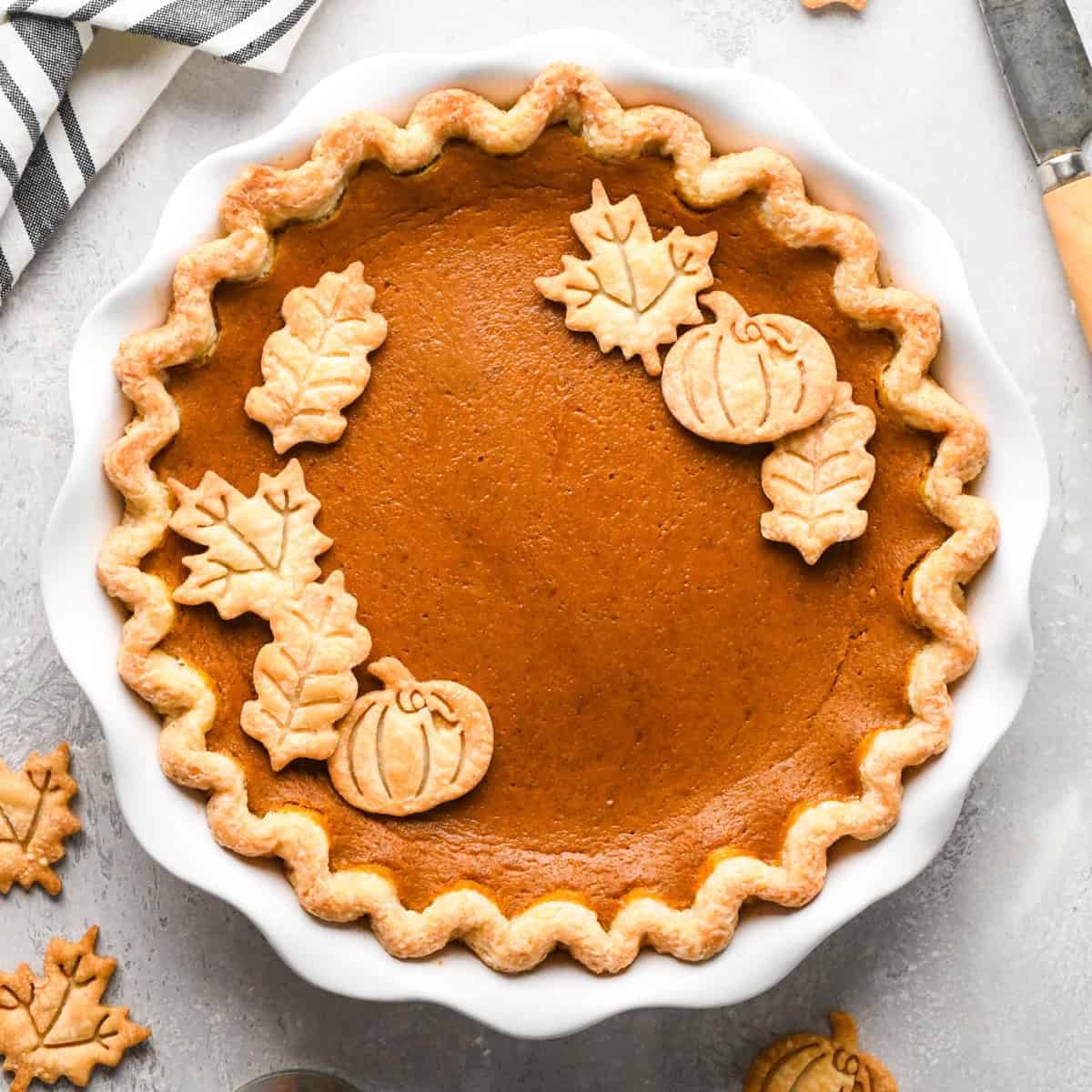
The Best Homemade Pumpkin Pie for Fall and Thanksgiving
Ingredients
Method
- Make the Pie Crust
- Combine flour, salt, and sugar in a food processor.
- Process with butter and cold water until the dough begins holding together.
- Form dough into a ball.
- Wrap and refrigerate for at least 2 hours or overnight.
- Make the Pumpkin Pie Filling
- Prepare filling while dough chills.
- Whisk eggs with pumpkin puree.
- Mix in cream, vanilla, sugar, salt, cinnamon, and pumpkin pie spice.
- Assemble
- Preheat oven to 425°F (218°C).
- Roll dough on a floured surface to fit the pie plate.
- Transfer and shape the crust.
- Add filling to the unbaked crust and protect the edges with a crust shield.
- Bake & Cool
- Bake at 425°F (218°C) for 15 minutes.
- Lower heat to 350°F (177°C) and bake 50–60 minutes, until edges are set and the center is slightly wobbly.
- Cool on a wire rack for 2 hours before serving or refrigerating.
Notes
Heavy cream: Half and half or full-fat coconut milk are alternatives.
Brown sugar: Dark brown sugar may be used.
Crust: Store-bought crust is an option.
Serve with whipped cream.
Refrigerate for up to 5 days.
Freeze wrapped pie for up to 2 months.
Nutrition values are approximate.
Homemade pumpkin pie is a classic American dessert with a smooth, creamy pumpkin filling, warm fall spices, and a buttery homemade crust. Made with pumpkin puree, brown sugar, cinnamon, and pumpkin pie spice, this pie is a wonderful addition to Thanksgiving dinner or any autumn gathering.
The filling comes together with a simple whisk, while the homemade crust adds a tender, flaky contrast to the rich pumpkin custard. You can also prepare the pie ahead of time, making holiday dessert planning much easier.
Timing note: The supplied recipe lists 2 hours 10 minutes total, but its instructions require at least 2 hours of dough chilling, 65–75 minutes of baking, and 2 hours of cooling. The table reflects those instructions rather than the shorter supplied total.
Why You’ll Love This Homemade Pumpkin Pie
- Homemade buttery crust: The combination of chilled butter and flour creates a tender pastry that complements the creamy filling.
- Smooth pumpkin custard: Eggs and cream help the pumpkin filling bake into a soft, sliceable consistency.
- Warm, balanced spices: Cinnamon and pumpkin pie spice bring familiar fall flavors without requiring a long ingredient list.
- Simple filling preparation: Everything comes together in one mixing bowl with a whisk.
- Great for making ahead: Pumpkin pie needs time to cool and can be refrigerated before serving.
- Flexible ingredients: Canned or homemade pumpkin puree, different cream options, and a store-bought crust can all be used.
Ingredients You’ll Need
This homemade pumpkin pie has two main components: a buttery pastry crust and a lightly sweetened pumpkin custard.
For the Pumpkin Pie Filling
- 3 large eggs
- 15 ounces pumpkin puree
- 1 cup heavy cream (or half and half)
- 1 teaspoon pure vanilla extract
- ¾ cup light brown sugar
- ½ teaspoon fine sea salt
- 2 teaspoons ground cinnamon
- 2 teaspoons pumpkin pie spice
For the Homemade Pie Crust
- 1¼ cups all-purpose flour
- ½ teaspoon sea salt
- 1 tablespoon granulated sugar
- ½ cup salted butter, chilled and cut into 1-inch pieces
- ¼ cup cold water
Understanding the Key Ingredients
Pumpkin puree: This provides the body, color, and earthy pumpkin flavor. Use plain pumpkin puree rather than pumpkin pie filling, which already contains additional sweeteners and seasonings.
Eggs: Eggs help the pumpkin mixture set during baking. They give the filling its characteristic custard-like texture.
Heavy cream: Cream adds richness and helps create a smooth filling. Half and half produces a somewhat lighter result.
Light brown sugar: Brown sugar sweetens the filling while adding a gentle molasses note that works especially well with pumpkin spices.
Cinnamon and pumpkin pie spice: These seasonings provide warmth and depth. Pumpkin pie spice typically contains cinnamon along with spices such as ginger, nutmeg, cloves, or allspice, depending on the blend.
Cold butter: Chilled butter is important for the pastry. Small pieces of butter incorporated into the flour help create a tender, flaky texture as the crust bakes.
Cold water: Cold water brings the pastry dough together while helping keep the butter from softening too quickly.
Easy Ingredient Substitutions
A few simple substitutions can make this recipe more convenient without changing its basic preparation.
Canned Pumpkin vs. Fresh Pumpkin Puree
You can use either 15 ounces of canned pumpkin puree or 2 cups of homemade pumpkin puree.
Canned pumpkin usually has a consistent texture and moisture level. Homemade puree can vary depending on the pumpkin variety and preparation method.
If homemade puree seems noticeably watery, drain some excess liquid before measuring. Too much moisture can affect how firmly the custard sets.
Heavy Cream vs. Half and Half
Half and half can replace heavy cream in the same quantity.
The filling may be slightly less rich, but the eggs will still help create the custard structure.
Full-fat coconut milk is another option, although it may introduce a mild coconut flavor and change the finished texture.
Light Brown Sugar vs. Dark Brown Sugar
Dark brown sugar can replace light brown sugar.
Because it contains more molasses, it creates a deeper sweetness and a slightly stronger caramel-like flavor.
Homemade vs. Store-Bought Pie Crust
A store-bought pie crust can save preparation time, particularly during busy holiday cooking.
Choose an unbaked crust that fits your pie dish and follow the filling and baking instructions. If using a different crust, check its package directions for any special handling.
How to Make Homemade Pumpkin Pie
Making pumpkin pie from scratch involves preparing the pastry, mixing the custard, assembling the pie, and baking it at two temperatures.
The first, hotter stage begins baking the crust and filling. Reducing the oven temperature allows the custard to finish setting more gently.
Step 1: Prepare the Pie Crust
Add the all-purpose flour, sea salt, and granulated sugar to a food processor. Pulse briefly to combine.
Add the chilled butter pieces and process until the mixture resembles coarse crumbs with small pieces of butter remaining.
Gradually add the cold water, processing just until the dough begins to hold together.
Avoid continuing to process once the dough can be gathered together. Excessive mixing can produce a tougher pastry.
Transfer the dough to a work surface and gently bring it together into a ball.
Wrap the dough and refrigerate for at least 2 hours or overnight.
Chilling helps the butter firm up and allows the dough to become easier to roll.
Step 2: Mix the Pumpkin Filling
While the pastry chills, prepare the pumpkin custard.
In a large mixing bowl, whisk together the eggs and pumpkin puree until evenly combined.
Add the heavy cream, vanilla extract, light brown sugar, fine sea salt, ground cinnamon, and pumpkin pie spice.
Whisk until the sugar and spices are incorporated and the filling has a smooth, uniform appearance.
Make sure no large pockets of unmixed pumpkin or spice remain.
Cover and refrigerate the filling if it will be sitting for an extended period while the dough chills.
Step 3: Roll Out the Dough
When the dough is ready, preheat the oven to 425°F (218°C).
Lightly flour a clean work surface.
Remove the dough from the refrigerator and roll it into a circle large enough to fit the bottom and sides of your pie plate.
Use enough flour to prevent sticking, but avoid adding excessive flour because it can make the crust dry.
Gently transfer the dough into the pie plate.
Ease the pastry into the corners without stretching it, then shape or trim the edges as desired.
If the dough becomes noticeably soft during handling, refrigerate the lined pie plate briefly before adding the filling.
Step 4: Add the Pumpkin Filling
Give the prepared pumpkin mixture a gentle stir.
Pour the filling into the unbaked pie shell.
The filling should sit evenly inside the crust without overflowing the edges.
Position a pie crust shield over the pastry rim to help protect it from excessive browning.
For easier handling, place the pie dish on a sturdy baking sheet if needed. This can also help catch small spills when transferring the filled pie to the oven.
Step 5: Bake at Two Temperatures
Place the assembled pie in the preheated oven.
Bake at 425°F (218°C) for 15 minutes.
Without removing the pie, reduce the oven temperature to 350°F (177°C).
Continue baking for another 50–60 minutes.
The filling is ready when the outer edges appear set and the center still has a slight wobble when the dish is gently moved.
Avoid baking until the entire center looks completely firm. Pumpkin custard continues to set as it cools, and excessive baking can cause cracking or a dry texture.
If the crust begins browning too quickly, make sure the edges remain protected.
Step 6: Cool Before Slicing
Remove the pie from the oven and place it on a wire cooling rack.
Allow it to cool for approximately 2 hours.
Cooling gives the custard time to finish setting, making the pie easier to slice cleanly.
Once cooled, serve the pie or transfer it to the refrigerator.
For a particularly neat slice, chill the pie before cutting and use a clean knife, wiping the blade between slices.
Tips for the Best Pumpkin Pie
Keep the Pie Crust Cold
Cold pastry dough is easier to handle and helps maintain small pieces of butter in the crust.
If the dough feels sticky or the butter begins softening while rolling, refrigerate it briefly rather than adding large amounts of extra flour.
Use Plain Pumpkin Puree
Pumpkin puree and pumpkin pie filling are not interchangeable.
Plain puree contains pumpkin without the added sugar and spices found in prepared pie filling. Using the sweetened product would change the balance of this recipe.
Mix the Filling Until Smooth
Whisk the filling thoroughly enough to incorporate the eggs, cream, sugar, and spices.
There is no need to beat it aggressively. Excessive whisking can incorporate unnecessary air into the custard.
Measure the Spices Carefully
This recipe uses both ground cinnamon and pumpkin pie spice.
Because pumpkin pie spice often already contains cinnamon, measure each seasoning accurately to avoid overpowering the pumpkin flavor.
Watch the Center, Not Just the Clock
Ovens and pie dishes can influence baking time.
Look for a set outer filling with a gently wobbling center rather than relying entirely on the stated minutes.
Give the Pie Enough Cooling Time
Cutting pumpkin pie immediately after baking can produce loose, uneven slices.
The custard becomes firmer as it cools, so patience makes a noticeable difference.
Common Pumpkin Pie Mistakes to Avoid
Mistake: Using Pumpkin Pie Filling Instead of Puree
Prepared pumpkin pie filling contains sweeteners and spices.
Adding the recipe’s sugar and spices on top can make the finished pie excessively sweet or strongly seasoned.
How to avoid it: Check the can and choose plain pumpkin puree.
Mistake: Overworking the Pie Dough
Too much processing develops gluten and breaks down the butter too finely.
This can produce a tougher crust instead of a tender pastry.
How to avoid it: Stop mixing once the dough begins to hold together.
Mistake: Pouring Filling Into an Overfilled Crust
A pie shell that is too shallow may not accommodate all the pumpkin custard.
Overflowing filling can make transferring the pie difficult and create a mess in the oven.
How to avoid it: Pour carefully and leave space below the pastry rim. The supplied recipe does not specify a pie-dish size, so use a dish that comfortably accommodates the filling.
Mistake: Baking Until the Center Is Completely Firm
Pumpkin pie is a custard pie, so it behaves differently from a standard cake.
Waiting until the center is completely rigid can lead to overbaking.
How to avoid it: Remove the pie when the edges are set and the center has a slight wobble.
Mistake: Slicing Before the Pie Has Set
Warm pumpkin custard may be too soft to hold a neat wedge.
How to avoid it: Allow the pie to cool thoroughly before slicing.
Pumpkin Pie Troubleshooting
Why Is My Pumpkin Pie Cracking?
Cracks commonly develop when pumpkin custard is overbaked or experiences excessive heat.
As the filling cooks, the eggs firm up. Too much heat can cause the custard to tighten and crack.
To reduce cracking, watch for a slightly wobbly center and avoid extending the baking time unnecessarily.
A cracked pie can still taste good. A spoonful of whipped cream can cover minor surface cracks when serving.
Why Is My Pumpkin Pie Filling Watery?
Excess moisture in pumpkin puree or insufficient baking can leave the filling softer than expected.
Homemade pumpkin puree can be particularly variable in moisture content.
Use thick pumpkin puree, measure ingredients accurately, and allow the pie to finish setting during cooling.
If the filling is still liquid after cooling, it may have been underbaked.
Why Is My Pumpkin Pie Crust Soggy?
Pumpkin custard is a moist filling, so the pastry beneath it may not become as crisp as the exposed edges.
A dough that is too warm or a crust that has not baked sufficiently can contribute to a softer bottom.
Keep the pastry chilled before baking, preheat the oven fully, and follow the initial high-temperature baking stage.
Why Didn’t My Pumpkin Pie Set?
Pumpkin pie needs the correct ratio of eggs, pumpkin, and dairy, enough baking time, and adequate cooling.
If the center is very loose after the expected baking period, continue checking its doneness rather than removing it based only on the timer.
Remember that a small wobble is normal, but liquid movement across the center indicates the custard needs further baking.
Pumpkin Pie Variations
Extra-Rich Pumpkin Pie
Use the full amount of heavy cream rather than half and half for a richer custard texture.
This version is especially suitable when serving small slices after a holiday meal.
Dark Brown Sugar Pumpkin Pie
Substitute dark brown sugar for light brown sugar to add a more pronounced molasses flavor.
The deeper sweetness pairs naturally with cinnamon and pumpkin pie spice.
Coconut Milk Pumpkin Pie
Use full-fat coconut milk in place of heavy cream.
This can change the richness, flavor, and texture, and the pie will still contain eggs and butter unless those ingredients are separately replaced.
Pumpkin Pie With a Ready-Made Crust
Use an unbaked store-bought pastry shell to reduce hands-on preparation.
It is a practical alternative when preparing several Thanksgiving dishes at once.
What to Serve With Pumpkin Pie
Pumpkin pie has a rich, gently spiced filling, so simple toppings usually work best.
Fresh whipped cream: A spoonful of lightly sweetened whipped cream adds an airy contrast to the dense custard.
A dusting of cinnamon: A small pinch of ground cinnamon reinforces the pie’s warm spices.
Vanilla ice cream: A scoop of vanilla ice cream is a good pairing when serving the pie slightly warm.
Coffee or tea: Freshly brewed coffee, black tea, or a warm spiced drink balances the sweetness of a pumpkin pie slice.
For a Thanksgiving dessert table, pumpkin pie also pairs nicely with apple desserts, pecan pie, or simple homemade cookies.
How to Store Homemade Pumpkin Pie
Pumpkin pie contains eggs and dairy, so it should be treated as a perishable custard dessert.
After the pie has cooled, cover it and transfer it to the refrigerator promptly. Do not leave it at room temperature for more than 2 hours in total.
Store the pie in an airtight container or cover the dish securely to prevent it from absorbing refrigerator odors.
Although the supplied recipe notes suggest refrigerating for up to 5 days, 3–4 days is the more conservative food-safety recommendation for a homemade egg-based pumpkin pie stored at 40°F (4°C) or below.
Can You Freeze Pumpkin Pie?
Yes. Pumpkin pie can be frozen for longer storage.
Allow the baked pie to cool safely, then refrigerate until chilled.
Wrap it securely in plastic wrap followed by a layer of aluminum foil, or use an appropriately sized freezer-safe container.
For the supplied recipe, the suggested freezing period is up to 2 months for best quality.
Thaw the pie in the refrigerator rather than at room temperature. The texture may become slightly softer after freezing and thawing.
How to Reheat Pumpkin Pie
Pumpkin pie can be enjoyed chilled, so reheating is optional.
If you prefer it slightly warm, place a slice in an oven-safe dish and warm gently in a low-temperature oven until it reaches your preferred serving temperature.
Avoid excessive heating because the custard may become dry or develop cracks.
For a faster option, microwave an individual slice in short intervals, checking frequently.
Do not repeatedly reheat the entire pie. Warming individual portions helps preserve the texture of the remaining slices.
Make-Ahead Pumpkin Pie
Pumpkin pie is a practical Thanksgiving dessert to prepare in advance because it needs substantial chilling and cooling time.
The pastry dough can be made the night before and refrigerated until you are ready to roll it.
The filling can also be prepared while the dough chills and kept covered in the refrigerator.
For the most convenient holiday schedule, bake the pie ahead of serving day, cool it safely, and refrigerate it. This frees up oven space for other dishes.
Add whipped cream immediately before serving rather than storing the pie with the topping already applied.
Frequently Asked Questions
Can I Make Pumpkin Pie With Canned Pumpkin?
Yes. This recipe uses 15 ounces of plain canned pumpkin puree. Avoid canned pumpkin pie filling because it already contains sugar and seasonings.
Can I Use Fresh Pumpkin Instead of Canned Pumpkin?
Yes. The recipe allows 2 cups of homemade pumpkin puree instead of the 15-ounce can. Use a thick, smooth puree and drain excess moisture if necessary.
Do I Need to Prebake the Pie Crust?
No. This recipe calls for pouring the pumpkin filling directly into an unbaked pastry shell, followed by baking at 425°F (218°C) before reducing the temperature to 350°F (177°C).
How Do I Know When Pumpkin Pie Is Done?
Pumpkin pie is done when the edges of the custard are set and the center still wobbles slightly. The filling continues to firm as the pie cools.
Can I Make Pumpkin Pie the Day Before Thanksgiving?
Yes. Pumpkin pie is an excellent make-ahead dessert. Bake it, cool it safely, and refrigerate it until you are ready to serve.
Can I Use Half and Half Instead of Heavy Cream?
Yes. Half and half can replace heavy cream in this recipe. The custard may be slightly less rich, but it should still set when properly baked.
Why Is My Pumpkin Pie Still Soft After Baking?
A slight wobble is normal while pumpkin pie is hot. The filling becomes firmer as it cools. If it remains runny after adequate cooling, it may have been underbaked or made with unusually watery pumpkin puree.
Should Pumpkin Pie Be Served Warm or Cold?
Pumpkin pie can be served chilled or slightly warm. For clean slices and a firmer custard texture, refrigeration before serving is helpful.






2 Responses