
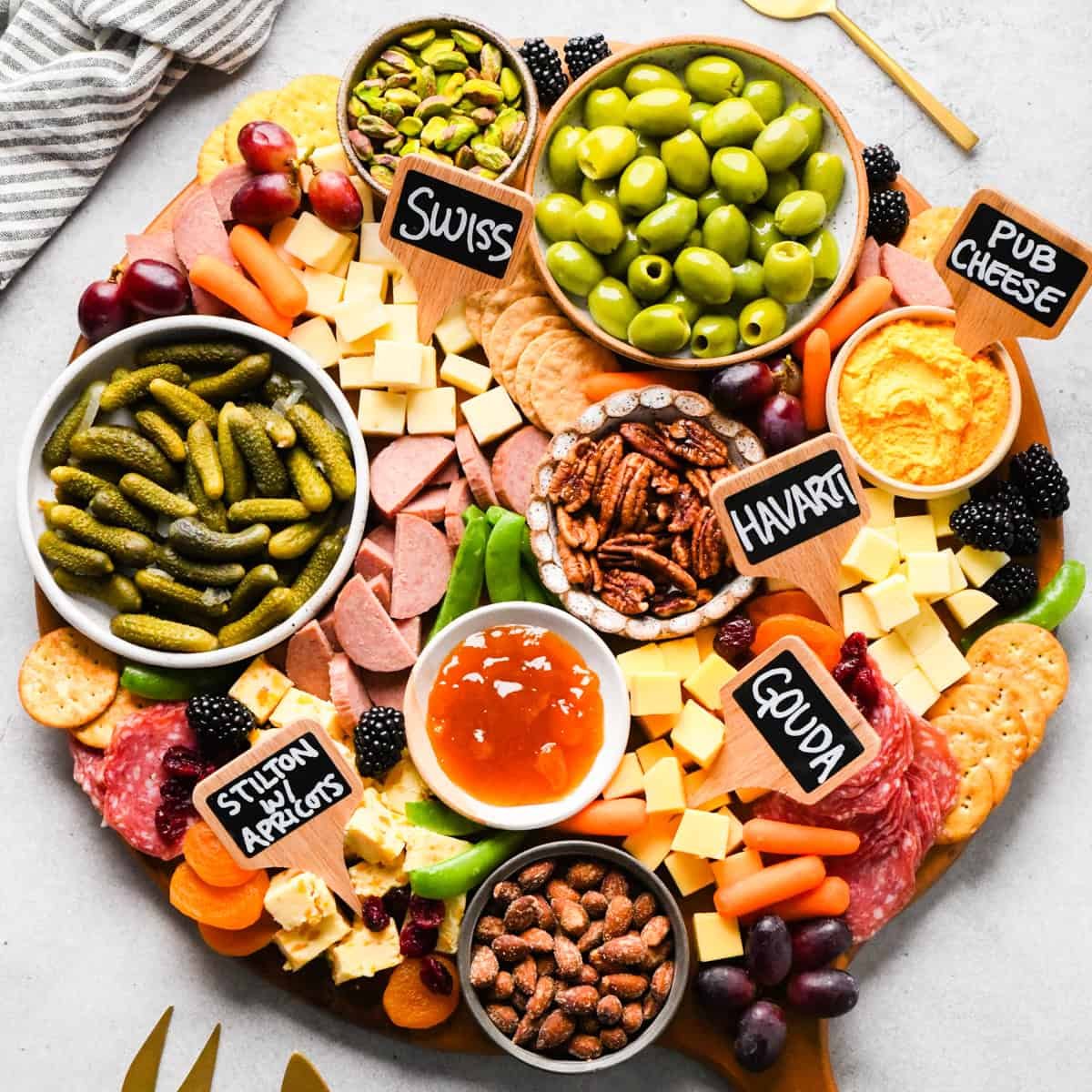
How to Make a Beautiful Charcuterie Board at Home
Ingredients
Method
- Prepare the Ingredients
- Wash and dry the grapes and blackberries.
- Drain and rinse olives and pickles, put them in small bowls.
- Transfer the nuts and dried fruit to small bowls.
- Cube cheese and slice meats.
- Assemble the Charcuterie Board
- Start with the cheese, evenly spacing the cheese varieties around the board. Try to make sure they don’t touch to avoid confusion when choosing which flavor to enjoy.
- Then, arrange the meat around the cheese. I like to use it as a “barrier” between cheese varieties.
- Next, fit the bowls of pickles, olives, nuts, dried fruit and jam.
- Then fill in the gaps with the fresh fruit and vegetables, evenly spacing them around the board.
- Add the cheese markers to each group of cheese.
- Serve with crackers.
Notes
Olives/Pickles: Rinse, dry and serve in individual bowls so their juices don’t mix with other components.
Fruit: Serve fruit in individual portions. Cut large grape bunches into smaller portions and make sure all fruit is washed and completely dry.
Vegetables: Cut into individual servings so guests can easily take them.
Dried Fruit & Nuts: Choose your favorite varieties. Serve nuts in small bowls to keep them crispy and prevent them from becoming soggy.
Apricot Jam: Serve alongside cheese and crackers for a sweet addition to the board.
Crackers: Choose your favorite varieties. Crackers can be served on a separate plate or board to prevent sogginess.
Assembly: Begin with the cheeses, add meats around them, position small bowls between the cheeses and meats, and fill remaining spaces with fruits, vegetables and crackers.
Serving Portions: Plan approximately 3 ounces of cheese and 3 ounces of meat per person when serving as an appetizer. For a main course, plan approximately 4 to 6 ounces of each per person.
Make Ahead: The board can be prepared up to 2 hours before serving. Cover tightly and refrigerate. Add crackers just before serving to prevent them from becoming stale.
Storage: Store leftover ingredients separately in airtight containers or storage bags in the refrigerator.
Nutrition: Each 4-ounce serving contains approximately 389 calories, 15 g carbohydrates, 20 g protein, 29 g fat, 13 g saturated fat, 3 g polyunsaturated fat, 11 g monounsaturated fat, 0.1 g trans fat, 66 mg cholesterol, 991 mg sodium, 340 mg potassium, 3 g fiber, 10 g sugar, 837 IU vitamin A, 3 mg vitamin C, 471 mg calcium and 1 mg iron.
Nutrition information is automatically calculated and should only be used as an approximation.
A charcuterie board is one of the easiest ways to create an impressive appetizer spread without spending hours in the kitchen. This colorful arrangement combines a selection of cheeses, cured meats, crunchy crackers, fresh fruit, vegetables, nuts, olives, pickles, and sweet accompaniments on one large serving board.
Learning how to make a charcuterie board is mainly about choosing ingredients that complement one another and arranging them so guests can easily build their own combinations. This guide explains what to include, how much food to prepare, how to arrange everything, and how to keep the board fresh until serving.
The recipe is designed for approximately 20 guests and takes around 30 minutes to assemble. It’s a convenient choice for holiday gatherings, birthdays, dinner parties, and celebrations where you want guests to have plenty of options.
Recipe at a Glance
| Detail | Information |
|---|---|
| Prep Time | 30 minutes |
| Total Time | 30 minutes |
| Servings | Approximately 20 people |
| Calories | 389 kcal per 4-ounce serving (estimated) |
| Course | Appetizer, Main Course |
| Cuisine | American |
| Preparation Method | No-cook assembly |
| Recommended Board | 20-inch cheese board |
Why You’ll Love This Charcuterie Board
- No cooking required: Most ingredients only need washing, slicing, portioning, or transferring into serving bowls.
- Plenty of variety: A combination of cheeses, meats, fruit, nuts, vegetables, and crackers gives guests different flavors and textures.
- Easy to customize: Choose cheeses and meats based on your preferences, budget, and dietary needs.
- Great for gatherings: Guests can help themselves without requiring individual appetizer plates to be prepared in advance.
- Flexible presentation: The ingredients can be arranged across one large board or divided into several smaller serving platters.
- Make-ahead friendly: Much of the preparation can be completed before guests arrive, with crackers added at the last minute.
What Is a Charcuterie Board?
A charcuterie board is a serving platter traditionally centered around prepared or cured meats. Modern American-style charcuterie boards often include a wider selection of foods, particularly cheeses, crackers, fruit, nuts, pickles, olives, and spreads.
The goal is to offer contrasting flavors and textures that work well together.
For example, salty salami pairs nicely with mild cheese, while sharp cheddar can be balanced by sweet fruit or jam. Crisp crackers provide structure, and pickles or olives add acidity between richer bites.
A good board doesn’t require expensive ingredients or elaborate decorations. Thoughtful variety, practical portions, and easy access to the food matter more than complicated styling.
What to Put on a Charcuterie Board
This recipe uses five cheeses, two cured meats, several crunchy and tangy accompaniments, and fresh produce.
1. Cheese Selection
Swiss Cheese — 10 ounces
Mild, nutty Swiss cheese provides a familiar flavor that pairs well with salami, grapes, and crackers.
Gouda Cheese — 8 ounces
Gouda adds a smooth, creamy, slightly nutty option. Depending on its age, it can range from mild to more pronounced in flavor.
Havarti Cheese — 8 ounces
Havarti has a soft, buttery flavor and works well with savory meats and crisp crackers.
White Stilton With Apricots — 8 ounces
This fruit-studded cheese contributes a sweet and tangy element, making it an interesting contrast to the cured meats.
Cheddar Cheese Spread — 9 ounces
Pub cheese provides a spreadable option that guests can enjoy with crackers, vegetables, or bread.
Using different textures makes the board more interesting. A combination of firm, creamy, and spreadable cheeses offers more variety than serving several cheeses with nearly identical characteristics.
2. Cured Meats
- 8 ounces dry salami
- 8 ounces summer sausage
Dry salami adds a savory, seasoned flavor, while summer sausage offers another cured meat option with a slightly different texture.
Slice the meats into manageable portions before assembling the board.
For presentation, you can fold thin salami slices or arrange them in overlapping rows. Summer sausage can be placed in small stacks or a curved line around the cheeses.
Keep the pieces easy to pick up without disturbing neighboring ingredients.
3. Olives and Pickles
- 8 ounces green olives
- 12 ounces small pickles or cornichons
Olives and cornichons add salty, tangy flavors that help balance rich cheeses and meats.
Drain and rinse them as directed, then dry them before serving.
Place each in a separate small bowl to prevent their liquid from soaking the cheese, crackers, or other ingredients.
4. Nuts and Dried Fruit
- ½ cup pistachios
- ½ cup candied pecans
- 1 cup smoked almonds
- 1 cup dried apricots
- ½ cup dried cranberries
Nuts add crunch, while dried fruit provides concentrated sweetness.
Smoked almonds create a savory contrast to the cheeses, and candied pecans add a sweeter option.
Dried apricots and cranberries pair especially well with cheese and crackers.
Serve nuts in small bowls where practical to keep them separate from moist ingredients and make allergen management easier.
5. Fresh Fruit and Vegetables
- 2 cups grapes
- 6 ounces blackberries
- 1 cup baby carrots
- 1 cup snap peas
Fresh produce adds color, freshness, and a lighter contrast to the richer ingredients.
Grapes are convenient for serving alongside cheese, while blackberries contribute a sweet-tart flavor.
Baby carrots and snap peas provide crunch and make the board feel more varied.
Wash and thoroughly dry all produce before arranging it.
6. Crackers and Sweet Accompaniments
- 16 ounces assorted crackers
- Apricot jam, amount as desired
Choose several cracker varieties with different shapes and textures.
Plain crackers allow the cheese flavors to stand out, while lightly seasoned crackers can provide additional variety.
Apricot jam adds a sweet contrast to salty meats and cheese.
Serve jam in a small bowl with a spoon so guests can add it without spreading it across the board.
How Much Meat and Cheese Per Person?
The amount of food needed depends on whether the board is served as an appetizer or a main meal.
| Serving Style | Cheese Per Person | Meat Per Person |
|---|---|---|
| Appetizer | Approximately 3 oz | Approximately 3 oz |
| Main course | Approximately 4–6 oz | Approximately 4–6 oz |
These are general planning guidelines rather than mandatory serving sizes.
For a group of 20 people, the appetizer guideline would require approximately 60 ounces of cheese and 60 ounces of meat.
The supplied ingredient list contains approximately 43 ounces of cheese, including cheddar spread, and 16 ounces of meat. Therefore, this particular board is best treated as part of a larger appetizer spread for 20 guests, especially when other food is available.
If the board will be the main meal, increase the meat and cheese quantities or provide substantial additional dishes.
Equipment You’ll Need
Having the right equipment makes serving and arranging the board easier.
- 20-inch cheese board: Provides a large surface for arranging several ingredient groups.
- Cheese markers: Help guests identify different cheeses without guessing.
- Cheese knives: Allow guests to serve themselves from larger cheese portions.
- Small bowls: Keep olives, pickles, nuts, and jam contained.
- Cutting board: Provides a separate preparation surface for slicing ingredients.
- Chef’s knife: Useful for cubing cheese and slicing sausage.
A wooden board, slate board, large serving platter, or several smaller platters can work.
If you don’t have a single large board, dividing the ingredients across two or three smaller boards may make the food easier for guests to reach.
How to Make a Charcuterie Board Step by Step
The easiest way to assemble a balanced board is to begin with the largest ingredients and gradually fill the remaining spaces.
Step 1: Wash and Prepare the Produce
Wash the grapes, blackberries, baby carrots, and snap peas.
Dry everything thoroughly with clean towels or paper towels.
Cut large grape clusters into smaller bunches so guests can take a portion without pulling apart a large cluster.
Prepare the vegetables in individual serving sizes where necessary.
Thorough drying is important because excess moisture can soften crackers and affect the texture of other foods.
Step 2: Prepare the Olives and Pickles
Drain the green olives and cornichons.
Rinse them if preferred, following the supplied recipe, and pat them dry.
Transfer each to a small serving bowl.
Using separate bowls keeps salty brine from spreading over the cheeses and crackers.
Step 3: Portion the Nuts and Dried Fruit
Measure the pistachios, candied pecans, smoked almonds, dried apricots, and dried cranberries.
Place them in small bowls or keep them ready in separate portions.
Dry fruit and nuts can fill small gaps later, but bowls are particularly useful when keeping nut varieties separate.
Step 4: Slice the Cheese and Meat
Cut the Swiss, Gouda, Havarti, and white Stilton with apricots into suitable serving pieces.
Some cheeses can be cubed, while others may be easier to serve in slices or small wedges.
Place the cheddar cheese spread in a small serving dish.
Slice the dry salami and summer sausage if they aren’t already sliced.
Keep the cheese and meats refrigerated while you finish preparation if they won’t be arranged immediately.
Step 5: Arrange the Cheeses First
Start by positioning the cheese varieties around the board.
Spread them out rather than placing all the cheeses together.
For example, position firmer cheeses toward different edges of the board and place the cheddar cheese spread in a small bowl near the center or another accessible location.
Leave space between the cheeses to make it easier for guests to identify and select their preferred variety.
The cheeses form the main structure of the arrangement.
Step 6: Add the Meats Around the Cheese
Arrange the salami and summer sausage in the spaces between the cheeses.
Fold or overlap slices to create compact groups.
The meats can act as visual separators between different cheese varieties.
Avoid stacking the meat too high or tightly, since guests should be able to remove individual slices without disrupting the board.
Step 7: Position the Small Bowls
Place the bowls of olives, pickles, nuts, dried fruit, and apricot jam into the remaining larger spaces.
Distribute them around the board rather than clustering everything in one place.
Bowls help create structure and keep wet ingredients away from foods that should remain dry.
If space is limited, move some nuts, dried fruit, or crackers onto smaller serving plates.
Step 8: Fill the Gaps With Fresh Produce
Add the grapes, blackberries, baby carrots, and snap peas.
Arrange contrasting colors next to one another to create visual variety.
For example, dark blackberries look appealing near pale cheese, while bright carrots can add color next to meats and crackers.
Fill gaps naturally without packing everything so tightly that guests have difficulty picking up individual ingredients.
Step 9: Add Cheese Markers
Place a label or cheese marker beside each cheese variety.
This is especially useful when several cheeses have similar appearances.
Clearly identifying the cheeses helps guests choose flavors they enjoy and avoid ingredients they don’t want.
Step 10: Serve With Crackers
Arrange the crackers around the edges of the board or on a separate serving platter.
Keeping crackers separate until serving helps prevent them from absorbing moisture.
Add cheese knives, serving spoons, and napkins.
Serve the board while the ingredients are fresh and properly chilled.
How to Arrange a Beautiful Charcuterie Board
Example of a balanced charcuterie arrangement with larger cheese groups, smaller bowls, and fresh produce filling the gaps.
A charcuterie board doesn’t need a perfectly symmetrical arrangement to look appealing.
In fact, grouping foods naturally can make the presentation feel more inviting.
Start With Large Ingredients
Cheese wedges, cheese spread bowls, and larger meat arrangements take up the most space.
Position these first so the rest of the board can be built around them.
Balance the Colors
Place ingredients with contrasting colors near one another.
Green grapes, orange carrots, dark blackberries, pale cheeses, and red-toned cured meats create a naturally colorful presentation.
Use Different Shapes
Mix cheese cubes, slices, folded meats, small bowls, and fruit clusters.
Varying shapes keeps the board from appearing too uniform.
Avoid Overcrowding
A generously filled board looks inviting, but guests still need room to reach the food.
Leave enough space around bowls and cheese groups for serving utensils.
Keep Wet Foods Contained
Olives, pickles, and jam should remain in bowls.
This prevents moisture from reaching the crackers and protects the texture of nearby ingredients.
Best Cheese Combinations for a Charcuterie Board
A balanced cheese board benefits from a variety of flavors and textures.
Rather than choosing five cheeses that taste similar, try combining:
- A mild cheese, such as Swiss or Havarti.
- A creamy cheese, such as Gouda.
- A sharper or more pronounced cheese.
- A sweet or fruit-studded cheese, such as white Stilton with apricots.
- A spreadable cheese, such as cheddar pub cheese.
This selection offers guests different ways to pair cheese with crackers, fruit, meat, and jam.
For instance, Swiss cheese works well with salami, while fruit-studded cheese pairs naturally with dried apricots or crackers.
Tips for the Best Charcuterie Board
Choose Ingredients With Different Textures
Combine creamy cheeses, firm cheeses, crisp crackers, crunchy nuts, juicy fruit, and chewy dried fruit.
Texture variety is just as important as flavor variety.
Prepare Produce Thoroughly
Wash and dry fruit and vegetables before assembly.
Excess moisture can make the board messy and soften nearby crackers.
Use Small Bowls Strategically
Small bowls keep loose ingredients contained and prevent liquids from spreading.
They’re especially helpful for olives, pickles, jam, and nuts.
Keep Crackers Separate Until Serving
Crackers can absorb moisture from cheeses, fruit, and pickles.
Add them just before serving or use a separate platter.
Make the Food Easy to Pick Up
Slice meats, portion cheeses, and divide grape bunches into manageable servings.
Guests shouldn’t need to cut everything themselves.
Use Separate Serving Utensils
Provide knives for different cheeses and small spoons for spreads.
Separate utensils can also help reduce cross-contact between foods, although a shared board cannot guarantee allergen separation.
Common Charcuterie Board Mistakes to Avoid
Adding Too Many Similar Cheeses
Several nearly identical cheeses offer less variety.
Choose different textures and flavor profiles instead.
Overcrowding the Board
Packing ingredients too tightly makes serving difficult.
Use a larger board or divide the ingredients across multiple platters.
Placing Wet Foods Directly on Crackers
Brine from olives or pickles can quickly make crackers soggy.
Keep wet ingredients in small bowls.
Not Preparing Enough Food
A board served as the main meal requires more food than one served before dinner.
Estimate portions based on the event and what other dishes will be available.
Assembling Too Far in Advance
Cut fruit can release moisture, crackers may soften, and refrigerated ingredients can lose freshness during extended display.
Prepare components ahead but finish the board close to serving time.
Easy Charcuterie Board Substitutions
The supplied ingredients are a starting point, not a strict requirement.
| Original Ingredient | Alternative | Difference |
|---|---|---|
| Swiss cheese | Another mild firm cheese | Different flavor and texture |
| Gouda | Another creamy semi-firm cheese | Changes the richness and flavor |
| Havarti | Mild cheddar or another soft-textured cheese | Different firmness and taste |
| White Stilton with apricots | Another fruit-studded cheese | Changes the sweet cheese element |
| Dry salami | Another preferred cured meat | Different seasoning and saltiness |
| Summer sausage | Another sliced sausage or cured meat | Different flavor and texture |
| Green olives | Preferred olive variety | Changes the briny flavor |
| Cornichons | Other small pickles | Different acidity and crunch |
| Pistachios | Other nuts | Changes flavor and possible allergens |
| Apricot jam | Another fruit preserve | Different sweetness and fruit flavor |
| Assorted crackers | Gluten-free crackers | Suitable alternative when selected carefully |
Choose substitutions based on your guests’ preferences, dietary needs, and the overall balance of the board.
Charcuterie Board Ideas for Different Occasions
Holiday Charcuterie Board
Use the original cheese and meat selection, then arrange grapes, cranberries, nuts, and jam for a festive presentation.
The red, green, and golden ingredients work well for Thanksgiving and Christmas gatherings.
Birthday Party Charcuterie Board
Offer familiar cheeses, mild meats, crackers, fruit, and easy-to-eat vegetables.
Keep stronger cheeses or spicy accompaniments in separate groups so guests can choose what they prefer.
Fall Charcuterie Board
Highlight dried apricots, candied pecans, smoked almonds, and apricot jam.
These ingredients pair well with richer cheeses and create a warm, autumn-inspired selection.
Vegetarian Cheese Board
Omit the cured meats and increase the selection of cheeses, crackers, vegetables, nuts, and fruit.
For strictly vegetarian guests, check cheese labels because some cheeses use animal-derived rennet.
Gluten-Free Charcuterie Board
Choose certified gluten-free crackers and verify the ingredients in cured meats, cheese spreads, and prepared condiments.
Use separate utensils and preparation surfaces if gluten cross-contact is a concern.
What to Serve With a Charcuterie Board
A charcuterie board can be served alone as an appetizer or alongside other dishes for a larger gathering.
Homemade dips: A bowl of homemade salsa or another savory dip provides an additional option for crackers and vegetables.
Fresh bread: Sliced baguette or other bread can complement the cheeses and spreads.
Light salads: A crisp green salad offers a refreshing contrast to rich meats and cheeses.
Baked appetizers: Bacon wrapped dates with goat cheese or caprese skewers can add variety to a party menu.
Fresh fruit platters: Additional berries, grapes, or sliced apples offer lighter options for guests.
For a substantial meal, include additional dishes rather than relying solely on the supplied meat and cheese quantities for 20 people.
How to Make a Charcuterie Board Ahead of Time
A charcuterie board can be assembled up to 2 hours before serving, according to the supplied recipe.
To prepare ahead:
- Wash and thoroughly dry the fruit and vegetables.
- Slice the cheeses and meats.
- Portion nuts, olives, pickles, and dried fruit.
- Arrange the cheese, meats, bowls, and produce on the board.
- Cover securely and refrigerate.
- Add crackers shortly before serving.
Keep the board refrigerated until guests are ready to eat.
If the board is too large to fit in the refrigerator, assemble it closer to serving time or store the individual components separately until needed.
Food Safety for Charcuterie Boards
Because a charcuterie board contains perishable meats and cheeses, proper temperature control matters.
Keep the ingredients refrigerated until serving.
As a general rule, perishable foods should not remain at room temperature for more than 2 hours, or more than 1 hour when the temperature exceeds 90°F (32°C).
For longer parties, serve smaller portions and replenish them with refrigerated ingredients rather than leaving the entire quantity out.
Use clean serving utensils and consider separate plates for guests with food allergies.
Charcuterie boards commonly contain dairy, nuts, wheat, and other possible allergens. Labels and separate utensils help guests make informed choices but cannot eliminate cross-contact on a shared board.
How to Store Charcuterie Board Leftovers
Store leftover ingredients separately whenever possible.
- Cheese: Transfer to suitable airtight containers or wraps and refrigerate according to the cheese’s storage requirements.
- Cured meats: Keep refrigerated in sealed containers and follow package instructions.
- Fruit and vegetables: Refrigerate in separate containers.
- Olives and pickles: Return to suitable covered containers with appropriate storage liquid if available.
- Nuts and dried fruit: Store separately to help preserve texture, following package guidance.
- Crackers: Keep dry crackers in an airtight container away from moisture.
Do not return perishable foods to storage if they’ve remained unrefrigerated beyond safe holding limits.
Exact storage periods depend on the products used, package instructions, and how long the ingredients were displayed.
Frequently Asked Questions
What Should Be on a Charcuterie Board?
A modern charcuterie board typically includes cured meats, cheeses, crackers, fresh fruit, nuts, pickles, olives, and spreads. Choose ingredients with different flavors and textures for a balanced selection.
How Do You Make a Charcuterie Board for Beginners?
Start with several cheeses, add sliced meats, position small bowls of olives and nuts, then fill the gaps with fruit, vegetables, and crackers. Keep the arrangement easy for guests to serve themselves.
How Much Cheese Do You Need Per Person?
A general appetizer guideline is approximately 3 ounces of cheese per person. For a main course, plan closer to 4–6 ounces, depending on what else is served.
How Much Meat Do You Need for a Charcuterie Board?
Plan approximately 3 ounces of cured meat per person for a generous appetizer portion, or 4–6 ounces when the board is serving as the main meal. Smaller amounts may be suitable when many other appetizers are available.
What Is the Best Size Charcuterie Board for 20 People?
A 20-inch serving board can be used as the centerpiece, but the amount of food may require additional platters. Board capacity depends on its shape, ingredient sizes, and whether crackers are served separately.
Can You Make a Charcuterie Board the Night Before?
You can prepare and portion many ingredients the night before. For best freshness, assemble the board closer to serving time, refrigerate it, and add crackers immediately before serving.
What Cheeses Are Best for a Charcuterie Board?
Choose a variety of mild, creamy, firm, and flavorful cheeses. Swiss, Gouda, Havarti, fruit-studded white Stilton, and cheddar cheese spread are the selections used in this recipe.
How Do You Keep Crackers From Getting Soggy?
Keep crackers away from wet foods such as olives, pickles, and cut fruit. Add them just before serving or arrange them on a separate platter.
Can You Make a Charcuterie Board Without Meat?
Yes. Replace the meats with additional cheeses, vegetables, fruit, spreads, and other vegetarian-friendly accompaniments.
How Long Can a Charcuterie Board Sit Out?
For food safety, perishable meats and cheeses should generally not remain unrefrigerated longer than 2 hours, or 1 hour in temperatures above 90°F (32°C).






One Response